Monday, August 5, 2019

Here come caudiciforms! (26 pics)

If you happen to follow me on Twitter you're already aware of and hopefully not too annoyed by my current obsession with caudiciforms. Same as with Adromischus last year and Anacampseros/Avonia the year before that, my interests shift and develop and inevitably include a new genus or type of plant to obsess about each year. It does not mean I'm neglecting any of my earlier passions. Those passions are very much alive and growing. But discovering new plants for oneself, as you surely know, is a special delight. From what I see within our plant growing community, my fascination with caudiciforms of all kinds was long time coming and could even be considered a natural progression of sorts. And yes, it probably means Haworthias are next! 😄

Before going on a shopping spree I did consider accommodations for the new plants. A corner in front of the balcony was not being used sufficiently, even though it is a really bright spot with lots of morning sunlight and ceiling-high windowpanes for vines to enjoy. I have also cleaned milk glass films from two panes to enable plants be placed floor level. And yet, it seems I have underestimated how large the leaves and vines can get! Luckily not all of the fat plants grow at the same time. I still have some wish plants in mind that I would like to get, but the collecting is practically over and the growing begins. The exciting part!
Here is the general setup, with some other plants strategically placed on windowsills.

You see those ginormous vines and heart shaped leaves? That's a Stephania (most likely rotundifolia or cephalantha). Got this one at the Essen succulent market some time ago after another Stephania species (the one with round leaves, S. erecta I believe) was snatched away from under my nose (this year's market was brutal!). The second choice has quickly become the main attraction. 

So much green and it's growing visibly every day. I swear I saw it move in front of my eyes one morning! I'm not used to this speed of growth with all those mesembs and co. She needs a lot of water to support all this, too. But these leaves are worth every effort.


Next are the two Cucurbitaceae (pumpkins) I got from the same place. Both for some reason have abandoned all vines except one, which then proceeded to grow until it reached the ceiling. They are still trying to continue growing, somewhere, somehow.
The leaves are very similar. Left is Cyclantheropsis parviflora, right - Momordica boivinii.


The caudex shape is quite different though. Momordica boivinii is still rather young but from what I understand the caudex will be something of a tree trunk.

It has been flowering, too, showing male as well as female flowers. The timing was not right for any pollination attempts.

Cyclantheropsis parviflora's caudex is flat with really nice bark. Honestly, bark of caudiciforms is so fascinating. Especially the way it splits and peels and then splits again when the caudex grows.


The whole thing with bark cracking when growing is of course most prominent in certain Dioscorea species. I have a couple of young Dioscorea elephantipes, while I'm not 100% sure the bigger plant is D. elephantipes. The smaller plant is just waking up.

The bigger one is actively growing and showing great climbing skills, too. Clever plant does not inflate its leaves until it gets a good grip somewhere. 


By the way, if you thought these are ball shaped underneath, the shape is more of a jelly fish.

I do have a big 30 cm Dioscorea, but it's a Dioscorea macrostachya (syn. mexicana) and being a summer grower it's dormant now. Hope it will wake up in March or so... It is alive and rooted. Fingers crossed.

That's no moon! It's a..... Raphionacme burkei. 

Very cool plant. Hope not to kill it.


It seems to be growing flowers at the moment, followed by leaves. It is supposed to be a shrub which is good because the Stephania is gonna take over the whole climbing trellis anyway.

If you thought this one is round underneath - nope! It's a turnip.


This is a Pachypodium bispinosum that I have to hide from the cat (not that she has ever shown any interest in chewing on plants). It's lodging with Haworthias and is growing well after some initial acclimation problems. I believe these can grow long branches but the previous grower has been carefully trimming them, it seems. I'll try to do the same.

Love the bark/leaf color contrast.

And no, it's not ball shaped. I don't even know what this is. A monster carrot?

What's really ball or coconut shaped is Ipomoea holubii (or Turbina holubii or Ipomoea bolusiana). I could not find any confirmation online that it is toxic, except one mention that the seeds are. Let me know it you know more. The cat does not show any interest in it but still.


Wednesday, April 17, 2019

The gift that keeps on giving: A Haworthia story (23 pics)

Winter is over! Warm and sunny days are coming and I can't wait to watch the plants grow. The weather is still being funky - we've had snow and -2°C on Sunday and +15°C with some sun/rain combination yesterday - but most of the lithops are watered and conophytums are sleeping and things on the windowsill are starting to change for the better. Well, except for the mealy bugs. Still need to deal with those...

I've been thinking what story to tell you and decided that something positive and uplifting would be best for the start of the season. I need some cheering up myself and this is what makes me smile these days. If you follow me on Twitter, you might know this story already. It's fun to tell it in detail though :)

Last year, when I was seriously getting into Adromischus, I also started growing more of the Haworthias. These plants can get rather large so I can't grow many. After browsing through those beautiful pictures online, how can you resist? Several plants have found their way to my home. Amongst them, a Haworthia splendens, you know, the fancy Japanese kind, with fat chocolaty leaves and everything. I was quite proud to call it my own but even before I could brag about it it just rotted away in what feels like a day. It turned into a nasty stinking mush without so much as a warning. Tough luck.


I was still hoping to save some of it so I kept pulling of leaves and cutting it to get to the healthy tissue until all what was left were two small half-leaves. I stuck them into pumice and left them alone. This was last May. 


A couple of months passed and contrary to expectations the leaves neither rotted nor dried up. They just shriveled a little and looked like this in August. 


And then, in September, things started happening! Those are new roots. How exciting is that?


And it gets better! Although it still takes several more months until then.

Last November the leaves finally started pushing new growth. 


And check out those roots!


By January I could already separate one of the baby-plants from the mother-leaf.


(This one kinda grows from the backside of the leaf because why not?)


In March, with a bit of sunlight, the chocolaty color started coming out, too. Along with the leaf pattern and texture.


Every little plant comes with its own fully developed root.


And the thing is, after I started separating bigger plant-babies, the leaves kept growing new ones. I already have five of them and they just keep coming!  I'm very excited to watch them grow and will let you know the final count :D


Sunday, December 16, 2018

Adromischus marianiae cultivation tips (23 pics)

I have been growing several Adromischus plants since 2014 but this is the first year I can watch many different types grow and develop. It's exciting and full of discoveries. Having watched them grow for a year or so does not make me an expert but the more I see the better I understand their yearly growing pattern and their needs.


The good news is they are doing very well on a windowsill and in pure pumice substrate! They are definitely not the genus that is "best in a greenhouse", in fact they don't even need that much sunlight. Half a day of it (the sun moves on after 2 pm here) and careful watering will produce compact and healthy plants.

While the red types develop a nice tan with intense sunlight, green types tend to get "bleached", turn lighter green or yellow. Here is my oldest plant. This year it started developing a second branch from below and is overall a nice and healthy one. The next two pictures are of this same plant, taken from two opposite sides. Can you tell which side is the sun-facing side? :D


When the sunlight get less intense the darker green color returns for those types that were supposed to be dark green like the below specimen.


The babies I grew from leaves in the recent years get greener during winter months, too.


But it also means that the "Lime Drops" variety that is actually supposed to be lighter green with pink tips is now also completely green.


And the "herrei" red types turn brownish green, too. The red color will return in the spring.


The new leaves are more intensely colored anyway. The below younger "alveolatus" variety plants have been growing some new red leaves this Fall. So pretty!


Adromischus marianiae "Little Spheroid" are really prone to stretching. I have a plant that stretches  in winter every year without fail. And then gets back to looking great by the end of summer.


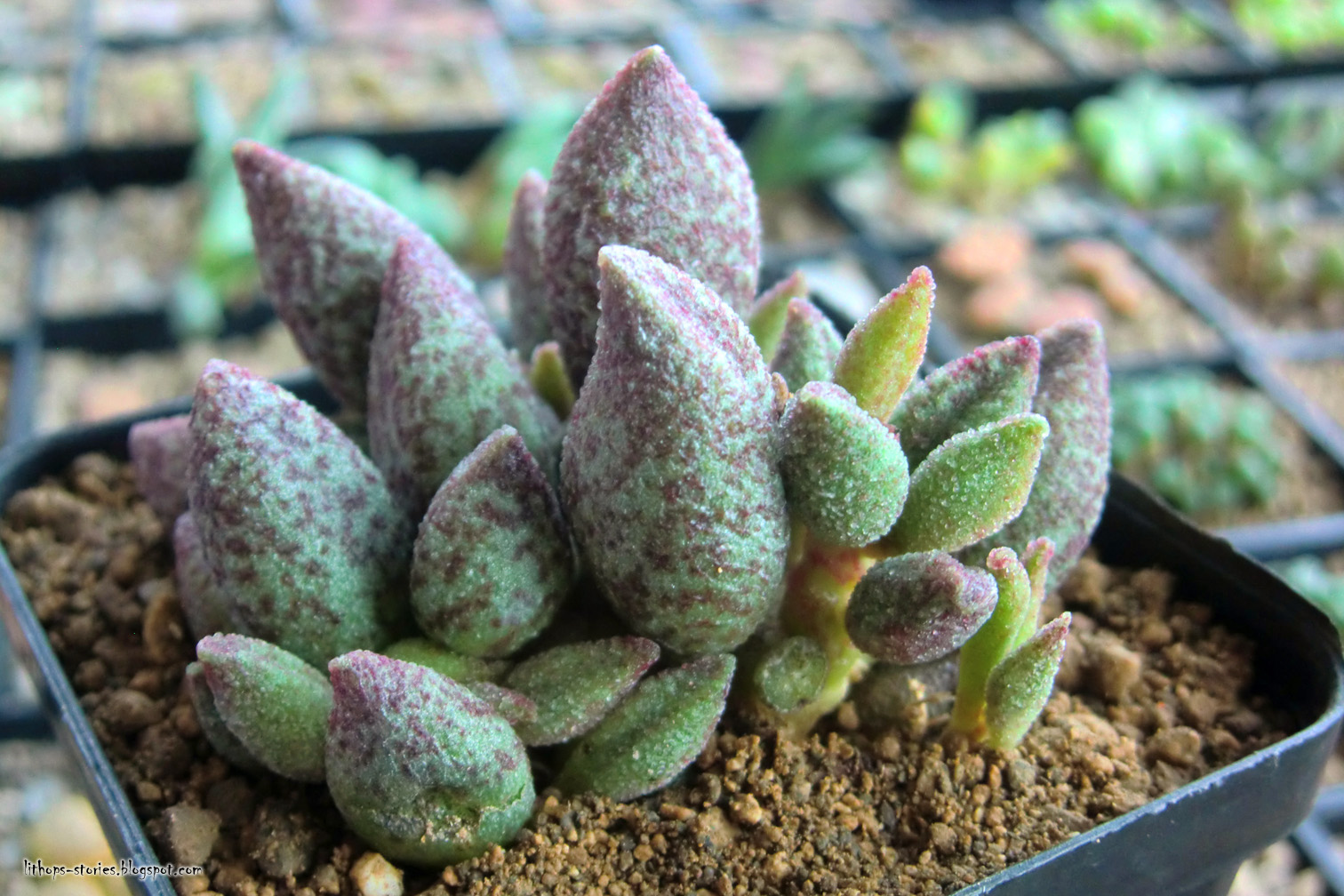
What I wanted to say is that shape improves with time. No need to fret about it. See the below plant? All the new leaves are narrow and pointy. As the year progresses they will get thick and round thus hiding the stems even better and contributing to the tight shape the plant is supposed to have.


Or, another example. I got these "Droedap" locality plants earlier this year with only two big leaves of an undefinable shape on each. But once they started growing all those perfectly shaped and beautifully colored leaves came out.


The coloring and pattern like the number of dots and spots varies as well. The below Adromischus trigynus barely has any dots on the new leaves. The typical pattern only develops with time as the leaves grow bigger.


There have been lots and lots of flowers, on the new plants as well as plants I've had for years (my pollination attempts have failed though). Most of the leaf cuttings have developed into proper little plants within a year and growing them from seed has turned out to be absolutely possible (although very slow). The only thing that is still standing between you and a windowsill full of Adros is their retail prices. Unfortunately the hype is not yet over. But at least if you have one plant, as it grows, you can create "backup copies" and won't need to spend money again if one of them withers. That's what I've been doing. Because boy I won't be able to re-purchase any of them.

Here are some plants I grew from leaf cuttings this year.


And here are the babies grown from seed that are now 1,5 years old. While it was fun to watch the seedlings grow if you're not as patient, growing Adros from leaf cuttings is the way for you.


I have already written about Adromischus propagation and other observations earlier this year. What I would like to address now is the yearly life cycle of these plants and how to water them.

Watering is actually quite easy. All you need to do is touch and squeeze the leaves a little. If they are soft, you may water. I have actually measured my watering can - one watering is ca. 15 ml tops, 10 ml to be on the safe side. You will notice that the leaves will be really firm the next day. From there you just leave it and water only when the leaves are getting soft again.

There are no periods of time with strict drought as with lithops. A little water all throughout the year is fine if you follow the above rule. The plants mostly rest in winter, not wasting the resources, so automatically you will water less frequently. And even if they continue growing during the winter months it's better to slow them down as much as possible since the lack of sunlight will otherwise cause etiolation. We don't want that. The growing of new leaves happens in spring and in the fall. And they will spend all summer growing inflorescences and flowering. I thought at first that if I don't allow them to flower they would grow more leaves but I now believe they would just sleep instead. So, summer is either for flowering or for resting. Note that the younger leaves increase in size over the course of several months, so if I say they would be resting it means they just won't be pushing new leaves. Existing leaves however will (ideally) continue growing in size to create the typical tight cluster.

Tight growth with hidden stems is also the shape to be maintained and supported. For example, as recent as last month my Adros were actively growing and some still seem to want to continue. However, the days got shorter and I already notice that some try to outgrow the tight shape. Time to reduce or stop watering to avoid stretching. Those succulent leaves have lots of resources to support themselves. And while the new leaves get thicker and rounder the overall "dense foliage" will be maintained.

What I wrote so far sounds quite easy but there are also some issues Adros might have. Like any succulent plants they do rot. The roots are very thick, caudex-like even, and the substrate should be appropriate. I use pure pumice. If you use something else at least in the upper half of the pot it should be just as airy. There is another thing I have seen a couple of times - some sort of white mold at the base of the leaves. No idea what the exact cause is (too damp would be my guess) but if you catch it early and remove the mold and the affected leaves the plant will be fine if kept dry for some time after.                                                                                                                                                                                                                      
There are so many different types and varieties of Adromischus marianiae out there that I am completely lost. I have no idea what exterior belongs to which name or locality. At this point I'm just trying to have plants of different shapes on my windowsill and I start to think assigning them numbers would make more sense. If you know how to keep them apart or where I can get reliable data on looks vs. name, I'd really appreciate your help.

Here are some plants whose proper names I can only guess about.